Pages

Pages

Friday, 30 December 2011

Spain sets out 8.9bn euros of new austerity measures


Spain's new conservative government has outlined 8.9bn euros ($11.5bn, £7.5bn) in new spending cuts and tax rises to lower the country's borrowing. The announcement is the first in a wave of austerity measures, with a total of 16.5bn euros to be cut in 2012. It also said Spain's 2011 deficit will be about 8% of its output - higher than the 6% seen by the previous government. The Popular Party last month ousted the Socialists from power at elections amid deep economic gloom. The government of new Prime Minister Mariano Rajoy has vowed to meet Spain's target of reducing the public deficit to 4.4% of gross domestic product in 2012, no matter what. On Friday, Deputy Prime Minister Soraya Saenz de Santamaria maintained a freeze on public sector wages for another year and ruled out practically all government hiring. "This is the beginning of the beginning," Ms Saenz de Santamaria said. "We are facing an extraordinary, unexpected situation, which will force us to take extraordinary and unexpected measures." Taxes on the wealthiest Spaniards will also be raised for at least two years, raising 6bn euros, she said. Spain's borrowing costs have jumped in the last year - reaching as high as 6.7% for 10-year debts - as investors feared that Spain might join Greece, the Irish Republic and Portugal in needing a bailout. The country's economy has shrunk sharply since a housing bubble burst in 2008, and it has an unemployment rate of 21%, the highest in Europe. The austerity measures have sparked a number of large protests across the country.

Thursday, 29 December 2011

Spanish airline Iberia has cancelled more than a third of its flights today due to a strike by pilots

Spanish airline Iberia has cancelled more than a third of its flights today due to a strike by pilots - affecting more than 10,000 passengers.

The strike has resulted in the airline being forced to cancel eight of its scheduled 16 flights between London Heathrow and Madrid.

Its pilots are striking because they fear job losses when company planes are diverted to Iberia’s planned new budget carrier.

Problems: Spanish airline Iberia has cancelled more than a third of its flights today due to a strike by pilots

Problems: Spanish airline Iberia has cancelled more than a third of its flights today due to a strike by pilots

HOW TODAY'S FLIGHTS HAVE BEEN AFFECTED

IB3163 London to Madrid (9.10am departure)

IB3166 Madrid to London 
(4pm departure)

IB3167 London to Madrid (6.40pm departure)

IB3170 Madrid to London (7am departure)

IB3171 London to Madrid (5.10pm departure)

IB3172 Madrid to London (3pm departure)

IB3176 Madrid to London (1.35pm departure) 

IB3177 London to Madrid (4pm departure)

Iberia said it scrapped 118 domestic and international flights but found seats on other Iberia flights or with other carriers for all the 10,000 travelers affected by the one-day strike.

The airline is not able to say how many passengers have been affected who are travelling between Madrid and London Heathrow.

Flights on planes belonging to Iberia Airlines franchise carrier Iberia Regional Air Nostrum - which flies from Glasgow and Manchester - are not affected by the strike.

Today's action is the second holiday-season walkout by pilots. 

The first was on December 18.Iberia plans to divert jetliners from money-losing domestic and medium-haul European routes for Iberia Express, which it hopes to launch early next year using lower-earning, newly hired pilots and flight attendants.

Big changes: The strike has resulted in Iberia being forced to cancel eight of its scheduled 16 flights between London Heathrow and Madrid

Big changes: The strike has resulted in Iberia being forced to cancel eight of its scheduled 16 flights between London Heathrow and Madrid

The company says its plans are for this carrier to have 40 planes in 2015.

Pilots union SEPLA threatened yesterday to stage more strikes over the creation of Iberia Express, fearing job losses among existing staff with the creation of the unit, designed to compete with budget airlines.

Iberia, Spain’s flagship carrier, insists that no job cuts are planned among its current 1,600 pilots.


The Civil Guard have recovered 1 million € in jewellery and watches which were stolen in May from stores on Madrid’s famous ‘Golden Mile’

The Civil Guard have recovered 1 million € in jewellery and watches which were stolen in May from stores on Madrid’s famous ‘Golden Mile’, the ‘Milla de Oro’ in the city’s Salamanca district.

Five people have been arrested and also face charges of drug trafficking, after officers confiscated more than three kilos of methamphetamine and another kilo of cannabis.

The first suspect to be arrested was a Ukrainian man who was caught in El Escorial in October selling luxury watches which had been stolen on the Golden Mile. His arrest led detectives to the gang’s main fences, two brothers who stored the merchandise in their parents’ home in the Canillas district of Madrid and used it as a meeting point with prospective purchasers.

The parents were also taken into custody when they were caught trying to throw the drugs which were on the premises out of the window.

Officers also seized 30,000 € in cash and four top range cars.

Search parties have been out on Lanzarote seeking a missing British tourist who was last seen near La Corona volcano

She was last seen near the Corona Volcano on Friday
Volcán de La Corona. Photo – Canario1/WikipediaVolcán de La Corona. Photo – Canario1/Wikipedia
enlarge photo


Search parties have been out on Lanzarote seeking a missing British tourist who was last seen near La Corona volcano last Friday afternoon. ‘Canarias 7’ names her as Margaret Holt, a 65 year old woman, 1.65 metres tall, with brown hair who was wearing a pink T-shirt, light brown shorts, white sandals and was carrying a small black rucksack when she disappeared.

She is a keen hiker and it’s understood that a map of hiking routes was found in the room where she is staying in the Hotel Barceló in Costa Teguise. She appears to have been planning to walk in the area of the Risco de Famara.

Anyone with any information on the missing woman is asked to contact either the central 112 emergency number, the fire brigade on 080 or the Civil Guard on 062.

U.S. national, named by Diario Sur as F.L.P., aged 54, who was wanted for crimes in both Spain and Belgium has been arrested in Fuengirola.

He was wanted by Spain and Belgium for money laundering and fraud
EFE archiveEFE archive
enlarge photo


A U.S. national, named by Diario Sur as F.L.P., aged 54, who was wanted for crimes in both Spain and Belgium has been arrested in Fuengirola.

Acting on information that he may have moved to this part of the Costa del Sol, police had been keeping the area under surveillance and took him into custody as he was leaving a shop in the Miramar district of Fuengirola on December 13.

He was wanted on an arrest warrant for alleged money laundering which was issued by Spain in April 2010, and on a European warrant from 2007 issued by the authorities in Belgium for fraud, money laundering and illicit association.

Two arrests have been made in the case of the German tourist, 67 year old P.A.C. who was found beaten to death in a tourist complex in Playa del Inglés

Two arrests have been made in the case of the German tourist, 67 year old P.A.C. who was found beaten to death in a tourist complex in Playa del Inglés, San Bartolomé de Tirajana, on the south of Gran Canaria, on Sunday.

The suspects are both Spanish and are named as 27 year old Diego P.L., who was arrested on Tuesday, and Cristóbal P.N., an 18 year old who was taken into custody the following day. The latter is reported to have been known to the victim, who let him into the apartment owing to their friendship. The teenager then opened the door to the other man when the tourist’s attention was distracted.

Police indicated to EFE on Thursday that the man died in the fight which ensued when he resisted their attempts to rob him. The suspects fled the scene with a laptop computer, two mobile phones and a small amount of cash. Both are reported to have lengthy criminal records.

The son-in-law of Spain's King Juan Carlos has been summoned to appear before a judge over allegations of corruption.

The son-in-law of Spain's King Juan Carlos has been summoned to appear before a judge over allegations of corruption.
A court in Palma, Majorca, has summoned the Duke of Palma, Inaki Urdangarin, to appear on 6 February.
The duke, married to Princess Cristina, is being investigated over claims he misused public funds given to a foundation he ran.
The former Olympic handball player has denied any wrongdoing.
In the wake of the accusations, the Spanish royal family on Wednesday made its accounts publicly available.
'Regrets'
Exact details of the accusations against the duke have not been made public.
However, Spanish media have said he is accused of misdirecting part of some 6m euros (£5m: $8m) sent to his not-for-profit Noos Institute by regional governments to organise sporting events.
It is alleged that some of the money ended up in companies that he ran. The events in question happened in 2004 to 2006 and the duke stepped down as head of the institute in 2006.
While denying any wrongdoing, the 43-year-old duke has said he regrets the "damage" caused.
Earlier this month, a spokesman for the duke said he had agreed with the palace not to take part in official duties while investigations continued.
The Spanish royal family responded to the allegations against the duke by announcing it would make available a full breakdown of its annual budget.
The palace said that the release of royal budget figures on Wednesday was in the spirit of transparency and modern times.

search is under way for a British pensioner who went missing during a hiking trip in the Canary Islands.

A search is under way for a British pensioner who went missing during a hiking trip in the Canary Islands.

Margaret Holt, 65, from Wirral, Merseyside, was last seen in Lanzarote on 23 December.

Her family contacted the Spanish Civil Guard after she failed to make contact over Christmas.

They are now in the country helping the search operation, which involves a dog team, rescue helicopters and volunteers.

Wendy Banks, Mrs Holt's daughter-in-law, appealed on Facebook for information about her whereabouts: "She is a very fit woman who thinks nothing of walking 20 miles per day. She loves coastal paths.

"We have her passport, cards etc from her room so know she only intended to go for a walk.

"Her mobile phone is with her but not working. We really believe she had a fall walking."

Mrs Holt was seen leaving her hotel in the resort of Costa Teguise on the morning of 23 December wearing a light pink vest, khaki shorts, walking sandals and a drawstring bag.

She was spotted later in the afternoon in the northerly Orzola region of the island but has not been seen since.

Civil Guard

The Foreign Office confirmed it had been informed about the disappearance.

A spokesman said: "The Spanish authorities are carrying out a search coordinated by the Civil Guard and local emergency services.

"Staff from the British Consulate are in contact with the authorities and the family."

Anyone with any information about Mrs Holt is asked to contact the Spanish authorities.

DISCLAIMER:Text may be subject to copyright.This blog does not claim copyright to any such text. Copyright remains with the original copyright holder.

Spain’s Iberia scraps 118 flights due to strike by pilots angry over planned budget affiliate


Spanish airline Iberia canceled more than a third of its flights Thursday due to a strike by pilots fearing job losses when company planes are diverted for use by Iberia’s planned new budget carrier. Iberia said it scrapped 118 domestic and international flights but found seats on other Iberia flights or with other carriers for all the 10,000 travelers affected by the one-day strike. 0 Comments Weigh InCorrections? inShare It was the second such holiday-season walkout by the pilots. The first was on Dec. 18. Iberia, Lineas Aereas de Espana, S.A., plans to divert jetliners from money-losing domestic and medium-haul European routes for Iberia Express, which it hopes to launch early next year using lower-earning, newly hired pilots and flight attendants. The company says its plans are for this carrier to have 40 planes in 2015. Pilots union SEPLA threatened on Wednesday to stage more strikes over the creation of Iberia Express, fearing job losses among existing staff with the creation of the unit, designed to compete with budget airlines.

Spain King's Son-in-Law Subpoenaed in Graft Probe


A judge subpoenaed the son-in-law of Spain's King Juan Carlos on Thursday to testify as a suspect in a corruption case, deepening a public relations nightmare for the royal family at a time of acute economic crisis for everyday people. The case surrounding Inaki Urdangarin, husband of the king's daughter Cristina, has been front-page news for weeks. But it went a big step further Thursday when Judge Jose Castro on the Mediterranean island of Mallorca named Urdangarin as a formal suspect in a criminal probe. The Balearic Islands Superior Court of Justice said in a statement that Urdangarin has been called to testify Feb. 6 in Palma, the capital of the archipelago. The one-page document did not mention allegations. But Spanish media say Urdangarin, 43, is suspected of siphoning money from public contracts awarded from 2004 to 2006 to a nonprofit foundation he then headed. He has not been charged with a crime. An official at the Royal Palace declined comment Thursday other than to say it "respects the decisions of judges." Spain has nearly 22 percent unemployment, a stagnant economy, mountains of debt and many other woes, so alleged shady business dealings by a member of the royal family look terrible for the Spanish monarchy. On Dec. 12 the Royal Palace shocked the country by announcing Urdangarin would for the time being stop taking part in official ceremonies involving the royal family. And in an unprecedented show of transparency, the palace this week made public the details of the stipend the royal family receives from the national budget. It said, for instance, that King Juan Carlos earns euro292,552 ($382,597) a year in salary and expenses and his son, Crown Prince Felipe, roughly half that amount. In his yearly Christmas Eve speech, the king expressed concern over what he described as the declining confidence among Spaniards in public institutions, a remark seen as a reference to the scandal surrounding his son-in-law, a commoner who used to be a professional handball player. Judge Castro's order Thursday made public an until-now sealed case file that the newspaper El Pais said contains 2,700 pages. Spanish newspapers have quoted investigators as saying Urdangarin is suspected, among other things, of having taken some of about euro6 million ($8 million) his nonprofit foundation received from the regional governments in Valencia and the Balearic Islands for organizing events such as sports seminars and diverting it to for-profit companies Urdangarin ran. The case is part of a broader, long-running corruption probe involving the regional government in the Balearic Islands. Since 2009 Urdangarin, the princess and their four children have lived in Washington, D.C., where Urdangarin works for the Spanish telecommunications company Telefonica, S.A. King Juan Carlos and Queen Sofia have three children. Crown Prince Felipe is the youngest, Princess Cristina is the middle child and the eldest is Princess Elena.

Tuesday, 27 December 2011

A prizewinning Spanish writer, Lucía Etxebarría, has told Spanish media that she is giving up her writing career

:Text may be subject to copyright.This blog does not claim copyright to any such text. Copyright remains with the original copyright holder.
A prizewinning Spanish writer, Lucía Etxebarría, has told Spanish media that she is giving up her writing career as she feels that illegal downloads of her books have caused a major problem not just to her but to writers across the world.
In an interview with El Pais newspaper she said "Today I have seen that more illegal copies of my latest novel have been downloaded than purchased". She went on to say that it was not worth her time writing. Comments she wrote on her Facebook page caused an outcry, leading to her eventually closing it down. Another page has been started asking her to set up a new page.
The writer was born in Valencis in 1966 and has won several big Spanish literary prizes including the Nadal prize and the Planeta prize, both of which come with large amounts of prize money.
Her latest book, called 'El contenido del Silencio' came out in October on Amazon and has seen dismal sales compared to her previous bestselling novels. She said "People are making millions out of online piracy by setting up in places like Belize...they are a powerful lobby and our government doesn't dare legislate."
In the ABC newspaper, she was quoted as saying that she had received "threats and insults" after her posting on Facebook and said that she could not understand why people had reacted so badly when she was just trying to protect the work of writers everywhere.
Illegal downloads have been a big problem for the music and film industries with various measures taken to try to at least slow down the pirates. It seems that now the written word is at just as much risk and some method of controlling what is downloaded from the Internet needs to be put in place. When dealing with something as large and diverse as the Internet , however, that is easier said than done


Forty-three percent of orange juice samples in Spain`s bars and restaurants were found to have more bugs than acceptable levels

Forty-three percent of orange juice samples in Spain`s bars and restaurants were found to have more bugs than acceptable levels, according to a new study.

The study, conducted by researchers from the University of Valencia, in Spain, found that poor handling of the oranges and insufficient cleaning of the juicer equipment stimulated bacterial contamination.

The team collected 190 batches of squeezed orange juice from different catering locations and analysed their microbiological content on the same day.

The results reveal that 43 percent of the samples exceeded the enterobacteriaceae levels deemed acceptable by food regulations in Spain and Europe. Enterobacteriaceae infects the human gut.

The researchers recommend that oranges are handled correctly, that juicers are washed properly and that the orange juice is served immediately rather than being stored in metal jugs.

Orange juice is known for its high content of vitamin C, carotenoids, phenolic compounds and other antioxidant substances.

The presence of Staphylococcus aureus (responsible for several difficult to treat infections) and the Salmonella species was found in one percent and 0.5 percent of samples, respectively. Salmonella infects cattle and poultry, causes food poisoning and typhoid.

Isabel Sospedra, study co-author warns that "generally, a percentage of orange juice is consumed immediately after squeezing but in many cases, it is kept unprotected in stainless steel jugs". :Text may be subject to copyright.This blog does not claim copyright to any such text. Copyright remains with the original copyright holder.

Monday, 26 December 2011

first major scandal to hit a member of Juan Carlos' family, judges are investigating alleged corruption involving a charitable organisation formerly run by Inaki Urdangarin, 43, the Duke of Palma de Mallorca.

Spain's King Juan Carlos has censured "irregular conduct" by public officials in his annual Christmas message, in a tacit reference to a corruption scandal facing his son-in-law.

"I am enormously worried by the lack of trust that seems to be spreading in some sectors of public opinion with regard to the credibility and prestige of some of our institutions," the King, 73, said in his televised address.

"All, absolutely all people with public responsibilities, have a duty to observe appropriate conduct," he added in the address, broadcast on Saturday evening.

In the first major scandal to hit a member of Juan Carlos' family, judges are investigating alleged corruption involving a charitable organisation formerly run by Inaki Urdangarin, 43, the Duke of Palma de Mallorca.

Urdangarin, a former Olympic handball player, is married to the King's youngest daughter, Princess Cristina.

The royal palace this month froze Urdangarin out of its official activities.

"When there is irregular conduct that is not legal or ethical, it is natural that society reacts," the King said.

"Any reprehensible action must be judged and sanctioned according to the law. Justice is equal for all."

He also called for Spain to unite to pull through its economic hardship, with the unemployment rate at 21.5 percent -- a level he called "unacceptable".

"We all know that the path of recovery with not be short nor easy, that it will require sacrifices," he said. "It is a crisis that is surely set to change our economic and social habits."

Following an announcement in October by the Basque separatist group ETA that it was ending its armed activity, Juan Carlos called on it to follow through by formally surrendering its arms and disbanding.

Friday, 23 December 2011

Prince Philip Taken To Hospital With Chest Pains


British royal officials say Queen Elizabeth II’s husband has been taken to the hospital after experiencing chest pains.

Buckingham Palace said Friday the Duke of Edinburgh was taken from Sandringham, the queen’s sprawling estate in rural Norfolk, to the cardiac unit at Papworth Hospital in Cambridge for “precautionary tests.”

Prince Philip, who is 90 years old, was at Sandringham for the royal family’s Christmas festivities.

Spaniards pay no tax on the winnings and winners can be offered extra by those wanting to use the tickets as a way of laundering money earned in the underground economy

Crisis-hit Spaniards this week sought a way out of their economic problems by betting massively on the world's biggest lottery, the Fat One – El Gordo – which distributed almost €2bn (£1.66bn) to winners around the country on Thursday.

After a nationwide spend of €2.7bn on lottery tickets, the main winners were the inhabitants of the small northern country town of Grañén, where €700m of prize money was handed out.

The town and its neighbouring villages are home to just 2,000 people – who won up to €400,000 each after buying shares in the top-paying lottery number.

The money promises to transform this farming community in the northern province of Huesca, which sits on the edge of one of Spain's harshest and most dramatic landscapes, the desert-like region of Los Monegros. Many of the winners were, like 23% of Spaniards, unemployed.

"A lot of businesses have closed here recently, so jobs are hard to find," said María Pilar Azagra, Grañén's sole lottery vendor.

"Now I can stop worrying so much about getting the sack," a bricklayer called Oscar said after picking up €400,000.

This year the state-owned national lottery increased the size of El Gordo prizes as Spaniards spent an average of €57 each on tickets. That was a slight fall, of 0.5%, on last year's spend.

Those who placed money on the winning number received 20,000 times the sum they had bet. Smaller prizes, some worth just a few euros, went to 27 million punters.

El Gordo's 100,000 numbers are divided up into fractions, with people placing anything from a few cents to €200 on their chosen number. Among the biggest winners were the members of the Housewife's Association of Sodeto, a village near Grañén, who shared out millions of euros.

The largest winner, however, is the Spanish state, which keeps 30% of the money spent on El Gordo. The €1bn it receives accounts for 0.1% of GDP, equivalent to almost 1% of this year's budget deficit target.

Azagra admitted she had failed to sell all the tickets with the winning number, sending many back on Wednesday night and allowing the state to hold on to the prize money.

El Gordo draw has kicked off Spain's Christmas celebrations every year since it was first drawn in 1812.

Champagne corks popped in the town square and in neighbouring villages as farmers, pensioners and the unemployed celebrated their luck.

"This makes up for a very bad year in which we have worked hard for very little reward," said Susana Pérez, who runs a small accountancy firm.

Farmers said they would be paying off bank loans used to buy irrigation systems.

One of the luckiest winners bought €80 worth of tickets bearing the lucky number hours before the lottery shop closed its doors on Wednesday. He walked away with €1.6m.

A Romanian immigrant, who asked to remain anonymous, also popped in to try his luck at what is a Spanish Christmas tradition.

"I had serious doubts about spending that much money on a ticket," he said after his €20 punt landed him €400,000.

Drinks were on the house at a Romanian-run bar in Huesca, the Carlitos, where bar staff had sold on shares in the winning number to their clients – who jointly collected €150m. "I am filthy rich!" shouted one customer, Antonio, at passing cars.

Bank managers and intermediaries for those wanting to launder dirty money by buying winning tickets were looking for the winners on Thursday.

Spaniards pay no tax on the winnings and winners can be offered extra by those wanting to use the tickets as a way of laundering money earned in the underground economy, which is thought to account for 17% of Spain's GDP.

Thursday, 22 December 2011

Man arrested in Spain over Madonna song leak


Spanish police have arrested and charged a man with illegally leaking an early version of a new Madonna song. The 31-year-old is alleged to have put a demo of Gimme All Your Luvin on the internet in November. The investigation began after lawyers traced the recording to Spain. The man, described by police as a big fan of the singer, was arrested in Zaragoza. Madonna's first studio album in five years is due for release in late March, with the first single out next month. Police have not named the man arrested, but confirmed his initials as J.M.R. Officers in the northern Spanish city said they found recordings of the song in a search of the suspect's belongings. Madonna, 53, was said to have been "very upset" when the song first leaked last month. Her manager, Guy Oseary, tweeted about the incident and asked fans to help police any further leaks. The singer's upcoming album, her first since 2008's Hard Candy, has already been completed and will be released as part of a new three album deal with Interscope Records. It was also recently announced that the star will perform during the high profile Superbowl half-time show on 5 February.

Tuesday, 20 December 2011

Gaddafi’s lost treasures:

.Many questions about Libya’s former leader, Muammar Gaddafi were left unsolved after his killing. Most of these questions are related to his treasures whose worth is estimated at billions of dollars. It seems like many are already trying to locate these treasures.
An Arab newspaper claimed on Monday that Niger had recently arrested two Libyans who were trying to infiltrate into its soil. They were equipped with weapons and advanced communication devices. During their investigation, the two admitted they had been hired by an American security company which is trying to find Gaddafi’s treasures. Apparently, before his death, the slain Libyan leader instructed his associates to bury his money and gold in secret places in the Western dessert.
According to the newspaper, the two were trying to reach an intelligence officer who was a close aide to Gaddafi. The officer whose full name is Said Qaman, “Moihi” could shed light on the locations of the lost treasures.
According to reports, “Moihi” is one of the most wanted people in the West. According to rough estimations, Gaddafi ordered to bury in the dessert 4 tons of gold, and cash money worth US$200-500 millions.
In a related development, eyewitnesses have reported an intensified activity of UAV in the border area between Libya and Algeria. These activities are probably part of the attempt to find Gaddafi’s lost treasures:Text may be subject to copyright.This blog does not claim copyright to any such text. Copyright remains with the original copyright holder

Sunday, 18 December 2011

The notion of a single currency for such a wide and diverse spread of nations is a nonsense.

 It is a monster out of control with no regard for the individual financial identities of the nations who so foolishly subscribe. Competition and therefore growth is best nurtured by the cust and thrust of currency against currency. To pool everything in a big pond is in contradiction to the competitive nature of trading. ....and indeed to human nature, our ancestors created the " Market" by their diverse inputs..so I would argue that multipility of currency in the market place is fundamental to our nature and has served us well for thousands of years! The EU and its "single currency" is "Fool's Gold"."it will never work. What will work is a currency, ergo identity, for each nation, joined in union of purpose, but not hat of worry over whose pennies are worth more than theirs. :Text may be subject to copyright.This blog does not claim copyright to any such text. Copyright remains with the original copyright holder.

EMERGENCY evacuation plans for Brits living in Spain and Portugal are being drawn up amid fears of the euro collapsing.


The drastic proposals emerged as a former Security Minister warned expats could be left stranded and destitute by the break-up of the single currency.

Brits who invested their savings in their adopted countries may not be able to withdraw cash and could even lose their homes if banks call in loans, worried ministers are warning.

The Foreign Office is preparing to bring them back from Spain and Portugal if the two countries are forced out of the euro, triggering a banking collapse.

A million Brits live in Spain and 50,000 in neighbouring Portugal – plus a million in the other eurozone countries.

And Baroness Neville-Jones, who only stepped down as a minister in May, called the situation “very, very worrying”.

The Tory peer – who once chaired the Joint Intelligence Committee for MI5, MI6 and other security agencies – said: “Spain is clearly a vulnerable area. If that happens, one of the things that will happen in a crash of that kind, is that the banks would close their doors. You would find that there are people there, including our own citizens, a lot of them, who couldn’t get money out to live on. So you would have a destitution problem.”

Wednesday, 14 December 2011

Spanish authorities are using stop and search powers abusively as a way to control migration,

. Amnesty International on Wednesday accused Spanish police of practicing widespread racial profiling, stopping people for identity checks based solely on people's ethnic or racial characteristics.
In a new report, the human rights group said certain police stations in Madrid had weekly and monthly quotas for the number of irregular migrants they have to detain, encouraging officers to target people belonging to ethnic minorities.
"People who do not 'look Spanish' can be stopped by police as often as four times a day," said Izza Leghtas, an Amnesty researcher on Spain, who called on the authorities to drop the practice.
A spokeswoman for the Interior Ministry on Wednesday rejected the allegation.
Amnesty said that under Spanish law police can check the identity of people in public places when there is a security concern. The group's research, however, revealed that deliberate identity checks on foreigners without any security concern is widespread.
"It is not only discriminatory and illegal — it also fuels prejudice — as those who witness such stops presume the victims to be engaged in criminal activities," said Leghtas.
Spain has more than 5 million foreign nationals, making up some 12 percent of the population. About half are European Union citizens while Moroccans, Ecuadoreans and Colombians form the largest groups of non-EU nationals.
Many of the immigrants came to Spain during the economic boom decade that ended in 2008 with the onset of the international financial crisis and a near two-year recession in Spain.
"The Spanish authorities are using stop and search powers abusively as a way to control migration," Leghtas said in a statement.
"Spain has the right to control migration, however, that should not be at the expense of the rights of migrants and minorities to equality and protection from discrimination," she said.
Spain now has an euro-zone high unemployment rate of 21.5 percent. The unemployment rate among foreign nationals is 32.6 percent.:Text may be subject to copyright.This blog does not claim copyright to any such text. Copyright remains with the original copyright holder

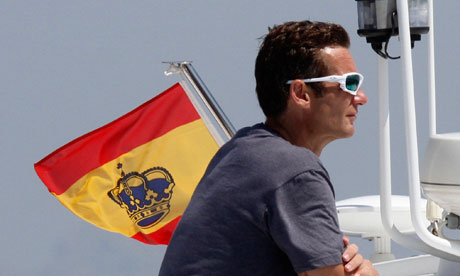
Iñaki Urdangarin, King Juan Carlos's son-in-law, is under police investigation into alleged fraud and misuse of public funds.

:Text may be subject to copyright.This blog does not claim copyright to any such text. Copyright remains with the original copyright holder.Spain’s king blocks scandal-hit son-in-law from royal duties
 Photograph: Reuturs


In an unprecedented move to clean up an increasingly tarnished reputation, Spain's royal family has blocked the king's scandal-hit son-in-law from representing the crown and pledged to open its accounts for public scrutiny.
Iñaki Urdangarin, who became Duke of Palma after marrying Princess Cristina in 1997, has agreed with King Juan Carlos to step aside from royal duties while a police investigation into alleged fraud and misuse of public funds continues, the head of the Spanish monarch's household, Rafael Spottorno, said.
"His behaviour has not been exemplary," Spottorno told journalists who were summoned to the Zarzuela Palace in Madrid.
Headlines in the newspapers suggested that Urdangarin, a former handball player turned businessman, may have been a lot worse than "not exemplary". El País, for example, accused him of taking up to €300,000 (£253,000) from the regional government of the Balearic Islands to set up a "fictional" office to promote the activities of a cycling team sponsored by the region's government.
It was just one of dozens of leaks from an investigation into suspected misuse of millions of euros of public funds that were allegedly channelled into private companies through a non-profit foundation presided over by Urdangarin.
A full-page opinion piece in El Mundo, meanwhile, called on the courts to treat Urdangarin – whose royal status allows him to give evidence by writing instead of in person – in exactly the same fashion as any other Spaniard.
"The story is always the same," wrote the lawyer Elisa de la Nuez. "Public bodies hand over large sums of money with virtually no control to the foundation presided over by Mr Urdangarin on the basis of his person and family connections motived by the fact that to do business in Spain it is important who you know rather than what you know."
Urdangarin, who is not yet officially under investigation and has not been charged, broke several weeks of silence about the case on Sunday.
"Given the number of articles and comment pieces appearing in the media about my professional life, I wish to make clear that I deeply regret the serious harm being done to my family and the royal family, which have nothing whatsoever to do with my private activities," he said from his home in Washington.
He has previously declared his innocence and said he is sure he will clear his name.
Newspapers have, however, reported that prosecutors are convinced the investigating magistrate in charge of a corruption and fraud inquiry involving the regional governments of the Balearic Islands and Valencia will soon officially name him as a suspect in the case. Charges, if presented, would be decided at a later date.
His lawyer, Mario Pascual, said that the king's son-in-law was "worried, upset, indignant … and fully convinced of his innocence".
Spottorno said the royal palace would provide a breakdown of the way it spends the more than €8m it receives from Spanish taxpayers every year.
This would appear on the royal family's website within weeks. He did not, however, reveal how much detail would be given.

Spanish police broke up one of the biggest forging scams in Europe

 Spanish police broke up one of the biggest forging scams in Europe, seizing 1.5 million euros ($2 million) in fake bank notes and arresting dozens of suspects, officials said on Tuesday.
"It is one of the biggest acts of forgery in Europe in terms of the quality and the amount of money printed," a statement from the national police said.
"The group had distributed more than two million fake euros in Spain and other European countries."
The forgers printed fake 50-euro notes in a building disguised as a canned food depot in Spain that was used as a front and also imported smaller forged notes from Italy, it said.
Photographs of the workshop released by police showed everyday office printers and paper cutters that were used to make the notes.
Police said they arrested a person suspected to be the main forger after an investigation into the gang by Spain with the European police agency Europol.
Europol said the gang had distributed the fake euros in 20 European countries and said 25 suspects were arrested overall.
Spanish police said the gang also carried out drug trafficking and they suspected it of links to the Camorra mafia in Naples, Italy.
"The investigation is ongoing and further arrests can be expected," Europol said in a statement.:Text may be subject to copyright.This blog does not claim copyright to any such text. Copyright remains with the original copyright holder.

Monday, 12 December 2011

MONTE Mayor golf club has sadly had to close – with no fixed plan to reopen.


The Marbella club, which opened in 1989, blames ‘disappointing operational results’ for the closure and said it will now concentrate on restructuring.

“Various alternatives will be reviewed during the coming weeks in order to come up with a viable way to continue operating the course and ensure investment value,” said club administrator Peter Geerlings.

“It will, of course, be re-opened as soon as practically possible,” he added.

“Awful news. It is one of the best courses in Spain,” commented Miranda Remie on the club’s Facebook page.

“We can only hope for a swift resolution and a new owner to restore this beautiful course to its rightful place amongst the top golf courses of the Costa del Golf,” said local man Reginald Hoare.

money laundering trial against the former Mayor of Marbella, Julián Muñoz, and his two exes, the singer Isabel Pantoja and his ex wife, Maite Zaldívar

The provincial court in Málaga has set the date for the money laundering trial against the former Mayor of Marbella, Julián Muñoz, and his two exes, the singer Isabel Pantoja and his ex wife, Maite Zaldívar. It starts on June 28 next year and is expected to extend into 2013.

The two women are charged with laundering funds for the ex Mayor and each face a possible three and a half years in prison. A fine of 2.6 million € has also been requested for Zaldívar.

Only two court sessions a week, on Thursdays and Fridays, have been set for the moment so as to not coincide with the sessions in the Malaya case, where Muñoz is also a suspect. He faces seven and a half years in prison in the money laundering case and fines of almost 7.5 million €.

The remaining seven suspects are the businessman José Miguel Villaroya, considered the right hand man to Muñoz and his wife, the businessman’s two children plus another member of the Villaroya family, Zaldívar’s brother Jesús, a former manager of a branch of Cajamar in Marbella and an ex stock broker

The Spanish government has confiscated 561,000 fake cigarettes, which were imported from China

The Spanish government has confiscated 561,000 fake cigarettes, which were imported from China and were paving their way into the Spanish market through the port of Valencia. The cigarettes were being transported in a container marked “synthetic fiber”.

China is the hub of fake cigarette dealers and they are mostly traded online. The trade of illegal cigarette products in large quantities on the internet has also increased dramatically, casting a huge shadow over the lawful cigarette trade in the country.

In November 2011, China Police busted around 122 criminal dens and arrested 78 suspects, following a raid in nine regions to crack a bogus cigarette manufacturing ring. Fake cigarettes were usually produced and stored in city outskirts and disguised as normal goods for delivery, with fake cargo and ownership details.

Puffing the fake cigarettes in large quantities or for a prolonged time will inevitably leave the smokers vulnerable to serious health damages. As per the lab findings of “The Organized Crime and Corruption Reporting Project” fake cigarettes from China are reported to contain 80% more nicotine and 130% more carbon monoxide, and impurities harmful for health.

These cigars are available at a cheaper price, and budget-constrained consumers end up smoking the fake ones.

In June, 2011 Philip Morris International Inc. (PM) had filed a case in U.S. District Court against local retailers in Miami for selling fake Marlboro cigarettes. The New York-based cigarette company tracked down 17 retailers who have been selling these cigarettes.

The extensive collection includes not only counterfeit smokes, but cigarettes with counterfeit tax stamps for almost all countries.

Other tobacco giants are also joining the fight against rampant black marketing of bootleg cigarettes on city streets. Way back in 2003, Lorillard Inc. (LO) had come forward to demolish the fake cigarette market and sued about 75 retailers in five states, 26 of whom were from Los Angeles alone.

In June 2011, British American Tobacco Plc. (BTI) Australia initiated legal action against six tobacco sellers, alleging them of selling Winfield Blue and Winfield Gold look-alike packets at two-third of the real price.

Spain’s war with fake cigarette owners had won a huge victory in November 2010, when the country’s biggest ever counterfeit cigarette network was dismantled in an operation. It had led to the seizure of 90 million fake cigarettes and the arrest of six men.

King Juan Carlos' son-in-law will stop taking part in official ceremonies because his business dealings are under investigation

King Juan Carlos' son-in-law will stop taking part in official ceremonies because his business dealings are under investigation, Spain's Royal Palace said today.

Inaki Urdangarin, 43, is suspected of siphoning away funds from public contracts awarded from 2004 to 2006 to a non-profit foundation he then headed.

The allegation looks terrible for the royal family at a time of acute hardship and economic crisis in Spain, where unemployment stands at 21.5 per cent.

Mr Urdangarin, husband of the monarch's daughter Princess Cristina, made the decision mutually with the Royal Palace, according to its chief of staff.

He has not been charged with a crime and issued a statement on Saturday saying he regrets the 'damage' the case is causing the royal family, but admitted no wrongdoing.

Rafael Spottorno, chief of staff at the palace, said Mr Urdangarin will be removed from the royal family's agenda and will no longer attend official ceremonies involving it.

He said it was not yet known if Princess Cristina would also stay away from activities.


Ceremony: Mr Urdangarin, far right, stands with (from left) Princess Letizia Ortiz, Crown Prince Felipe, King Juan Carlos, Queen Sofia, and his wife Princes Cristina


Duties: Princess Cristina at the World Swimming Championships in Barcelona in 2003. She lives with her husband in Washington D.C.

The couple and their four children now live in Washington, D.C., where Mr Urdangarin works for Spanish telecommunications company Telefonica.

Spanish newspapers, quoting investigators, have reported that he is suspected of taking part of around €6million the foundation received from regional governments in Valencia and the Balearic Islands for organising events such as sports seminars.

The money is said to have gone to for-profit companies he ran.

The case is part of a broader, long-running corruption probe involving the regional government in the Balearic Islands, the capital of which is Palma on the island of Mallorca.

News of the scandal has made the front page of Spanish newspapers for the past two weeks and forced the Royal Palace to take the rare step of addressing publicly the activities of one of its members.

Mr Spottorno said that by the end of December, the Royal Palace website will publish a breakdown of the money earmarked for the family in the government budget. In 2011, it was €8.43million.

King Juan Carlos and Queen Sofia have three children.

Crown Prince Felipe is the youngest, Princess Cristina in the middle child and the eldest is Princess Elena.

Sunday, 11 December 2011

new law which will declare Spanish mortgages to be "illegal and unenforceable"

.Aida Quinatoa is a tiny, soft-spoken Ecuadorean woman who still wears the colourful, ribbon-trimmed hats of the Quechua-speaking people of Bolívar province as she wanders the streets of Madrid, her new home city.
A dozen years after emigrating to Spain, where she works as a cleaner, Quinatoa is leading a rebellion against banks that have left hundreds of thousands facing destitution.
Her latest move is to have a bill in the Ecuadorean parliament that will declare punitive Spanish mortgages illegal and allow her countrymen to escape the debt collectors by returning home. "Most Ecuadoreans arrived here between 1998 and 2002, fleeing an economic crisis at home," she said.
"We found work but we couldn't find places to live. Landlords wanted six months' payment up front and a Spaniard to guarantee payment, so we ended up packed together in tiny flats with whole families in single rooms."
But as Spain's immigrant population increased fivefold with the arrival of almost five million people over the first decade of the 21st century, the banks identified a new source of income. "The savings banks began inviting us to free cultural events," she said. "They would also tell us how to get mortgages, telling us that property was a good investment. They offered loans of 120% of the value of a home."
Banks and estate agents were in league, talking immigrants into taking out vast loans with terms they often did not understand. Quinatoa saw a "lovely big apartment" and was told to put down a deposit. But then she was told it was no longer available. Rather than return the money, the agency offered a much smaller apartment. In the end, she borrowed €164,000, including a €14,000 personal loan to pay the agency's fee.
In the meantime, she was told that she must also offer her home as collateral for another Ecuadorean family. "We just went to the notary, or to the bank, and signed," she said. "It was a way to find somewhere decent to live."
Then Spain's vast property bubble burst and unemployment surged to 23%. The pyramid of loans and guarantees shoring up some €3.5bn of debt collapsed. Now only 29% of Spain's 400,000 Ecuadoreans are up to date on their repayments, but those who cannot pay fall foul of a Spanish law that means banks can repossess homes while only cancelling half of the mortgage and charging repossession "costs".
Eduardo, a 43-year-old builder from Quito, will lose his Madrid flat in May but will still be heavily indebted to the bank. "I'd leave now, but I am worried about the people who put up the guarantee," he said. "We are honourable people," said Quinatoa. "And we like to pay our debts. But this system is impossible and unfair."
The leader of Madrid's Ecuadorean immigrant association, Quinatoa represented groups who blocked access to homes due to be repossessed, forcing bank officials to back off and negotiate.
When a bank rang Quinatoa to say it wanted to repossess her flat to cover the debts of the family for whom she had stood as guarantor, she led a march to the Caja de Ahorros del Mediterraneo (CAM) bank that had sold many immigrants their mortgages. "They just rang and said, 'We are going after your house," she said. "But banks don't like people protesting at their doors, so they accepted the keys to the other flat in return for cancelling the debt."
In the end it was not Quinatoa who went bankrupt, but CAM – one of several savings banks to have folded because of reckless property loans.
Getting money back from immigrants can be difficult, especially if, as many homeless Ecuadoreans and a lot of British buyers on the "costas" have done, they just run home. However, Spanish banks have other ways to recover money. British law firms are, for example, being hired to go after those owing money on holiday homes. With Ecuadoreans, though, they simply package up the loans and sell them on to others.
One eager buyer has been Banco Pichincha, an Ecuadorean bank that has set up in Spain. "The bank is asking people to put up properties inEcuador as collateral," Quinatoa explained. "That means if you can't pay here, they can take your property there."
Pichincha has denied it will go after those who return home, but Ecuador's parliament looks set to act anyway.
Last year Quinatoa travelled to Quito with the draft of a new law which will declare Spanish mortgages to be "illegal and unenforceable" and allow her countrymen to free themselves from an otherwise inescapable debt trap.:Text may be subject to copyright.This blog does not claim copyright to any such text. Copyright remains with the original copyright holder

Saturday, 10 December 2011

Passengers planning to fly Ryanair next summer, beware

Passengers planning to fly Ryanair next summer, beware: charges on Europe's biggest budget airline will soar in 2012. Checked-in bag fees paid in advance increase by two-thirds, while travellers checking in a bag at the airport without booking ahead face a fee of £100 – up 150 per cent.

The airline has divided 2012 into low and high seasons, with the latter stretching across the summer from June to September, as well as Christmas. In peak season, the cost of checking in a single 15kg bag rises from £15 to £25, totalling £200 for a family of four on a return trip. The price for a second bag will be even higher, at £45.

Ryanair claims such fees are intended to change passenger behaviour in order to keep costs – and therefore fares – low. Stephen McNamara, a spokesman for the airline, said "Over 70 per cent of Ryanair passengers will be unaffected by these changes as they already travel with no checked-in bags."

But Ryanair's cabin-baggage rules are less generous than its rivals. The maximum volume is 44 litres, compared with the industry standard of 63 litres, as used by easyJet and British Airways. BA also allows a laptop or handbag up to 32 litres. The weight limit for Ryanair is 10kg; for BA, 23kg; and for easyJet there is no maximum. Ryanair enforces its limits strictly. The charge for passengers who breach the airline's strict size or weight is £40.

Seven seamen have been rescued after their ship collided with another vessel and sank in the Bay of Biscay

Seven seamen have been rescued after their ship collided with another vessel and sank in the Bay of Biscay, about 250 miles (402km) from Land's End.

The Florece and the chemical tanker Afrodite collided at about 03:30 GMT, Falmouth Coastguard said.

The Florece's crew left the sinking ship on two life rafts, before being rescued by a container ship - the Ocean Titan - that came to their aid.

The Afrodite's crew were able to remain on board their vessel.
Collision admission

After the collision, an emergency beacon went off, informing Falmouth Coastguard that the Dominican Republic-registered vessel was sinking.

The Cornish station contacted the nearest ship, which was the Afrodite, which admitted there had been a collision and it was involved, Falmouth Coastguard said.

The Bahamas-registered Afrodite attempted to deploy a rescue craft but was unsuccessful because of the sea swell.

Falmouth Coastguard helped co-ordinate the rescue operation with Spanish counterparts to rescue the crew of the Florece - a mix of Russians, Polish and Ukrainians.

Falmouth Coastguard watch manager Terry Collins said: "All seven crew of the Florece are safe and well which is an excellent outcome."

The Afrodite was not reported as taking on water.

Friday, 9 December 2011

Gib victor is a lawyer and studied at Oriel College at Oxford. He has concentrated on human rights cases and acts as a commercial lawyer for one of the largest and best known international firms in Gibraltar. He’s married and about to become a father. He’s also the grandson of a Spanish republican

It took some time to do the counting, but with each voter having to choose ten names from a list of 30 from the three parties, it’s hardly surprising the result took some hours to come, even if the total electorate in Gibraltar is only 21,712.
Turnout was a record high of 82.5% and the polls were confirmed as correct when the final result came in.

After some 15 and a half years in power 55 year old Peter Caruana, of the GSD, has been defeated by his 39 year old challenger, Fabián Picardo, and his coalition between Socialists and Liberals.

The Social Democrats of Caruana have ended up with seven seats while Picardo’s GSLP-LP has obtained ten seats. Yvette del Agua, Joe Holliday and Lianne Azzopardi are no longer in parliament. The official percentages were:
Alliance 48.88%, The GSD 46.76% and the PDP 4.36%.

The victor is a lawyer and studied at Oriel College at Oxford. He has concentrated on human rights cases and acts as a commercial lawyer for one of the largest and best known international firms in Gibraltar. He’s married and about to become a father. He’s also the grandson of a Spanish republican;

His grandmother arrived in Gibraltar after the Spanish Civil war, and then married a Gibraltarian. He benefitted by 1988 legislation on the Rock which granted their youngsters who wanted to, the possibility of studying in the U.K.

Departing Peter Caruana said that he left Gibraltar a better place after 15 years, and he congratulated Picardo ‘to this privileged office’. He offered him a full briefing on current issues and ended his speech with the words ‘God speed to you all’.

only the King and Queen, the Princes of Asturias and their daughters the Princesses Leonor and Sofía, given their proximity to the Spanish crown, would supposedly have had access to the state-funded budget.

It had been rumoured that the royal family of Spain has “for some time” been considering limiting the number of its members. Had such plans gone ahead, only the King and Queen, the Princes of Asturias and their daughters the Princesses Leonor and Sofía, given their proximity to the Spanish crown, would supposedly have had access to the state-funded budget.

As it stands, the royal budget is decreed by law and falls beyond any changes or reforms made to state finances.

Currently, those who make up the royal family, and as such are required to attend official acts in representation of the noble household, are the monarch, his wife and the Princes of Asturias as well as the King’s daughters the Infantas Elena and Cristina and Cristina’s husband Iñaki Urdangarín.

Only the King and Queen and the Princes of Asturias, and consequently their two daughters, rely exclusively on the royal budget which is assigned by the State to the royal household and freely distributed by the monarch, Don Juan Carlos as stipulated in the Constitution.

Accounts for the 2011 financial year assigned a total of 8.4 million Euros to the Royal Family, 5.2% less than in 2010. The king allocates a part of the allowance to the “upkeep of his family” while the rest goes towards expenses and the wages of household staff.

Thursday, 8 December 2011

Britons win case against Spanish developers


Peter and Benjamin Schmidt were found guilty by an Alicante court of fraud, sentenced to two years in prison and ordered to repay the £50,000 deposit taken from Keith and Marilyn Brown in 2004. A total of 60 people, mostly British, paid deposits in excess of £50,000 for property sold off-plan via the German father and son company Construciones Monte Puchol S.L. Within the space of a year the expectant homeowners began to realise that building licenses had not and would not be granted to the Schmidts, who had illegally earmarked 'rustic' land on which to build the 60 properties. It remains to be seen whether the decision will set a legal precedent and enable remaining victims, not just of the Schmidts, but of all fraudulent developers in Spain, to claw back their losses. Despite the allegations of fraud and the evidence against the Schmidts, the Browns were required to fund the six-year legal action themselves – something that has left a bad taste in the mouth of Mr Brown, particularly as there is no guarantee that the Schmidts will actually pay back what they owe. "In the UK, if a fraud is committed the police investigate the case and the Crown Prosecution Service pays the cost of the action," he said. "Here we have had to pay for everything ourselves. "Many of the other victims of this scam lost everything and were unable to pay legal fees so just had to walk away. From meeting and talking to other people who were involved there has been an immense amount of heartache and distress caused. I wonder why the Spanish authorities do not provide a legal system that is responsive to the need for a quick legal remedy." Mr Brown said that if it had happened in the UK, UK law would allow an action to sue the conveyancing lawyer directly for not checking the validity of the building licence. Under Spanish law they were unable to take that action. "It is about time the Spanish authorities and lawmakers woke up to the fact that the delay in getting a fair and just outcome is seriously detrimental to the Spanish economy," he said. Despite the positive result there is still the possibility of the Browns having to pay legal fees for an appeal hearing in Madrid and further fees for recovering their losses from the Schmidts and/or the lawyers from Javea. "Our resolve continues to be tested but we intend to continue in our search for justice," said Mr Brown. The Schmidts have been linked to a number of similarly bogus developments along the southern Spanish coastline during the early 2000 boom years of Spanish development and construction. When it became clear to investors that their homes would never materialise, the Schmidts attempted to maintain the fraud by offering to transfer investors' interest to their other property developments in Sagra and Benidoleig. At one stage the Browns were sent a cheque from the Schmidts to cover the airfare to visit one of their alternative developments, only for the cheque to bounce. After that, the Browns decided to instruct a new firm of lawyers to recover their deposit on the original development. Telegraph Expat's Spanish Planning Scandal campaign is supporting the thousands of expats who have been affected by the illegal homes crisis in Spain. You can find all the latest news on the situation here. Share:     inShare 1 Expat Property Overseas Property » Expat » Expat News » Spanish Planning Scandal »   Spanish planning scandal campaign   The Telegraph Weekly World Edition   Expat Directory   Expat picture galleries

On the run, U.S. financier finds Spanish refuge


He's wanted for contempt of court in Arizona. He is under investigation by Italian police over his connection with an international bond scandal exposed by Reuters in August and totalling at least $500 million (320 million pounds). And he is named as a key player in one of the first criminal indictments following the collapse of Iceland's economy. But last week you could find David Spargo in a holiday resort on the Spanish island of Majorca. He's a regular at La Batucada cocktail bar, where he might be drinking anything from a cocktail to a beer or whisky. Locals say he also enjoys playing on the 95-euro-a-round (81 pound) Alcanada golf course, which overlooks the sparkling Mediterranean. Since he arrived in Majorca early this year he has even tried to issue more bonds, one source told Reuters. Spargo's case shows how tough it is for regulators and law enforcement agencies to track and punish alleged financial crimes across borders. Networks of 'shell companies' -- paper-only firms with few real operations -- make it hard enough to identify suspects. Even if regulators can identify them, they are often hard to bring to justice. Spargo may be of interest to officials in at least four jurisdictions around the world but police and civil guard officials on Majorca said they were unaware of the fraud investigation. The 44-year old American is sought by U.S. Marshals for failing to repay $5.5 million to investors in Texas and Virginia who had bought bonds issued by his company. But because the charges against him are civil ones, the United States is not able to extradite him and the U.S. embassy in Madrid says they are not aware of Spargo's presence in Spain. Iceland and Britain (whose top financial services regulator recently called $500 million of bonds Spargo issued in 2008 a "fraudulent instrument") have also not tried to extradite him. A prosecutor in Italy declined to say whether authorities had tried to extradite anyone in connection with the case. "There are likely to be hundreds of suspected white-collar criminals who have moved to other countries and are now living off the proceeds from their alleged crimes," says Andrew Gordon, forensic services partner at accountants PricewaterhouseCoopers (PwC). Police in the City of London say more and more criminals are trying to hide their operations in different countries, using myriad bank accounts to siphon off the profits. Spargo himself denies any fraud. "A lot of your information is extremely incorrect," he told a Reuters reporter from the balcony of his second-floor apartment on November 28. "You'll find out in the next three days."

Spanish royal family hit by fraud scandal


The once squeaky-clean Spanish royal family has become immersed in a growing fraud scandal that reveals how members of King Juan Carlos's family may have cashed in on the monarchy's good name. At the centre of the scandal is the king's son-in-law Iñaki Urdangarin, a former Olympic-medal-winning handball player who became the Duke of Palma after marrying Juan Carlos's sporty daughter, the infanta Cristina. Urdangarin and his business partners are the subject of daily leaks from a fraud investigation involving millions of euros of public money as Spain's royal family struggles to hold on to its popularity. Police have raided the offices of his private companies and of a foundation he once presided over, taking away documents. El País newspaper reported this week that prosecutors believe Urdangarin, who has not been charged with any wrongdoing, will be named as a formal suspect in the case within two months. That could be a first step towards formal charges being placed. The royal palace, meanwhile, added fuel to the scandal this week by suggesting Juan Carlos planned to cut the official royal family down to a nuclear core – in effect casting off his son-in-law and daughter. On Thursday morning the palace press office appeared to have received a royal ticking off and publicly backtracked, saying "it deeply regretted having contributed to the fact that some media outlets reported this erroneously". Urdangarin himself, who now works for Spain's Telefonica phone company in Washington DC, has said he is innocent. "When I know the details of the investigations being carried out … I will be able to comment on their contents," he said last month. "My professional behaviour has always been correct." Queen Sofia, meanwhile, has showed public support for her beleaguered daughter and son-in-law, allowing the latest edition of Hola magazine to publish pictures of her visiting them at their home in the US. Speculation in Spanish newspapers has included predictions that Urdangarin will drop his aristocratic title so he can continue as a businessman or that Cristina will renounce her position as seventh in the line to the throne. Within a few years of abandoning his sports career in 2000, and after studying at a prestigious business school, Urdangarin became the owner of a €6m (£5m) house in Barcelona. He set up various companies and became president of a nonprofit foundation, the Nóos Institute. The institute boasted that its patrons included Urdangarin, his wife, an accountant described as an "assessor to the royal household" and professors from two of the world's top business schools, the Barcelona-based Iese and Esade schools. Nóos landed multimillion-euro contracts to organise events for regional governments in the Balearic Islands and Valencia. But public prosecutors in Palma, the capital of the Balearics, have said there is evidence the institute was a front, charging hugely inflated fees and siphoning money off to Urdangarin's private companies. A €1.2m contract with the Balearic Islands was, prosecutors told investigating magistrate José Castro, "totally disproportionate to the task … based exclusively on a fictitious budget which did not analyse a single cost". They said evidence pointed to the foundation being used exclusively to channel money to other companies – many in the names of Urdangarin or his business partners. "That was the sole aim," they said. At least €3.2m out of €5m was passed on from Nóos to Urdangarin's companies, according to Publico newspaper. The scandal comes as the royal family loses support among ordinary Spaniards. A regular poll by the state-run Centre for Sociological Investigation shows that, for the first time since polling started 17 years ago, trust in the royals has fallen below the halfway mark. Spaniards now place greater trust in the press.

Friday, 2 December 2011

Hundreds of metres under one of Iceland's largest glaciers there are signs of an imminent volcanic eruption that could be one of the most powerful the country has seen in almost a century.


Mighty Katla, with its 10km (6.2 mile) crater, has the potential to cause catastrophic flooding as it melts the frozen surface of its caldera and sends billions of gallons of water surging through Iceland's east coast and into the Atlantic Ocean.

"There has been a great deal of seismic activity," says Ford Cochran, the National Geographic's expert on Iceland.

"There have been more than 500 tremors in and around the caldera of Katla just in the last month, which suggests the motion of magma. And that certainly suggests an eruption may be imminent."

Scientists in Iceland have been closely monitoring the area since 9 July, when there appears to have been some sort of disturbance that may have been a small eruption.

Eruption 'long overdue'

Even that caused significant flooding, washing away a bridge across the country's main highway and blocking the only link to other parts of the island for several days.

"The July 9 event seems to mark the beginning of a new period of unrest for Katla, the fourth we know in the last half century," says Professor Pall Einarsson, who has been studying volcanoes for 40 years and works at the Iceland University Institute of Earth Sciences.

Start Quote

It means you actually see the crust of the earth ripping apart”

Ford CochranIceland expert, National Geographic

"The possibility that it may include a larger eruption cannot be excluded," he continues. "Katla is a very active and versatile volcano. It has a long history of large eruptions, some of which have caused considerable damage."

The last major eruption occurred in 1918 and caused such a large glacier meltdown that icebergs were swept by the resulting floods into the ocean.

The volume of water produced in a 1755 eruption equalled that of the world's largest rivers combined.

Thanks to the great works of historic literature known as the Sagas, Iceland's volcanic eruptions have been well documented for the last 1,000 years.

But comprehensive scientific measurements were not available in 1918, so volcanologists have no record of the type of seismic activity that led to that eruption.

All they know is that Katla usually erupts every 40 to 80 years, which means the next significant event is long overdue.

Smoke billows from a volcano in Eyjafjallajokull on 16 April 2010Eyjafjallajokull's relatively small eruption in 2010 halted air traffic across Europe

Katla is part of a volcanic system that includes the Laki craters. In 1783 the chain erupted continuously for eight months generating so much ash, hydrogen fluoride and sulphur dioxide that it killed one in five Icelanders and half of the country's livestock.

"And it actually changed the Earth's climate," says Mr Cochran.

"Folks talk about a nuclear winter - this eruption generated enough sulphuric acid droplets that it made the atmosphere reflective, cooled the planet for an entire year or more and caused widespread famine in many places around the globe.

"One certainly hopes that Katla's eruption will not be anything like that!"

The trouble is scientists do not know what to expect. As Prof Einarsson explains, volcanoes have different personalities and are prone to changing their behaviour unexpectedly.

"When you study a volcano you get an idea about its behaviour in the same way you judge a person once you get to know them well.

"You might be on edge for some reason because the signs are strange or unusual, but it's not always very certain what you are looking at. We have had alarms about Katla several times."

Changing climate

He says the fallout also depends on the type of eruption and any number of external factors.

Iceland fissures 1 December 2010Iceland is the only place where the mid-Atlantic rift is visible above the surface of the ocean

"This difficulty is very apparent when you compare the last two eruptions in Iceland - Eyjafjallajokull in 2010 and Grimsvotn in 2011.

"Eyjafjallajokull, which brought air traffic to a halt across Europe, was a relatively small eruption, but the unusual chemistry of the magma, the long duration and the weather pattern during the eruption made it very disruptive.

"The Grimsvotn eruption of 2011 was much larger in terms of volume of erupted material.

"It only lasted a week and the ash in the atmosphere fell out relatively quickly.

"So it hardly had any noticeable effect except for the farmers in south-east Iceland who are still fighting the consequences."

Of course, volcanoes are erupting around the world continuously. Scientists are particularly excited about an underwater volcano near El Hierro in the Canary Islands, which is creating new land.

But Iceland is unique because it straddles two tectonic plates and is the only place in the world where the mid-Atlantic rift is visible above the surface of the ocean.

"It means you actually see the crust of the earth ripping apart," says Mr Cochran. "You have an immense amount of volcanic activity and seismic activity. It's also at a relatively high altitude so Iceland is host to among other things, the world's third largest icecap."

But the biggest threat to Iceland's icecaps is seen as climate change, not the volcanoes that sometimes melt the icecaps.

They have begun to thin and retreat dramatically over the last few decades, contributing to the rise in sea levels that no eruption of Katla, however big, is likely to match.